Supporting deaf children’s experiences
Helping hearing parents to navigate a new world of connection and communication with their child.
Over 90% of children are born to hearing parents who may be completely new to deafness. A deaf child’s experience of the world will be different to a hearing person’s, and even mild deafness can have a huge impact on a child’s education and wellbeing. Working with BID Services, Togetherness created a dedicated new learning pathway, Understanding your deaf child, specifically for hearing parents of deaf children.
A different starting point
For many hearing parents, having a deaf child can feel like stepping into a completely new world – and not always knowing where to start. Kimberley Campbell‑Nottage is the Community Coordinator/Parenting Coordinator at BID Services and a member of the deaf community. Growing up profoundly deaf herself and now raising four children, she’s seen both sides – and recognised how much support parents need early on. With the Togetherness team, Kimberley designed ‘Understanding your deaf child’ to aid parents as they begin their journey, building more confidence and better connection using support that’s tailored to people’s lived experience. “The majority of deaf children are born to hearing parents who don’t have that ready-made community. I grew up with deaf parents and a deaf brother at home, meaning BSL was my first language and communication was natural and accessible. Being part of the deaf community gave me a strong sense of identity, culture and belonging from an early age. It also meant that I didn’t experience communication as a barrier in the same way that many deaf children do when they grow up without full access to language.”
Building the right foundations
“When my children were born, I saw a continuation of these same issues – the different experiences for deaf children. My children already shared a language with me; they could sign the basics by the time they began nursery. For other deaf children who had hearing parents, it was very rare that they’d arrive at nursery age with any language. Most of them would have minimal or no language, so they were already behind compared to deaf children with deaf families. I wanted my own children to grow up knowing that being deaf is not something that limits what they can achieve, and to have a strong identity, access to BSL and the opportunity to communicate fully with the people around them. My own experiences have made me very aware that being deaf does not, in itself, prevent a child from developing, communicating, learning, or maintaining positive emotional wellbeing. What makes the greatest difference is whether a child has full and consistent access to communication, language, education, and people who understand and support them. When these foundations are in place, they can thrive and achieve their full potential.”
Communication comes first
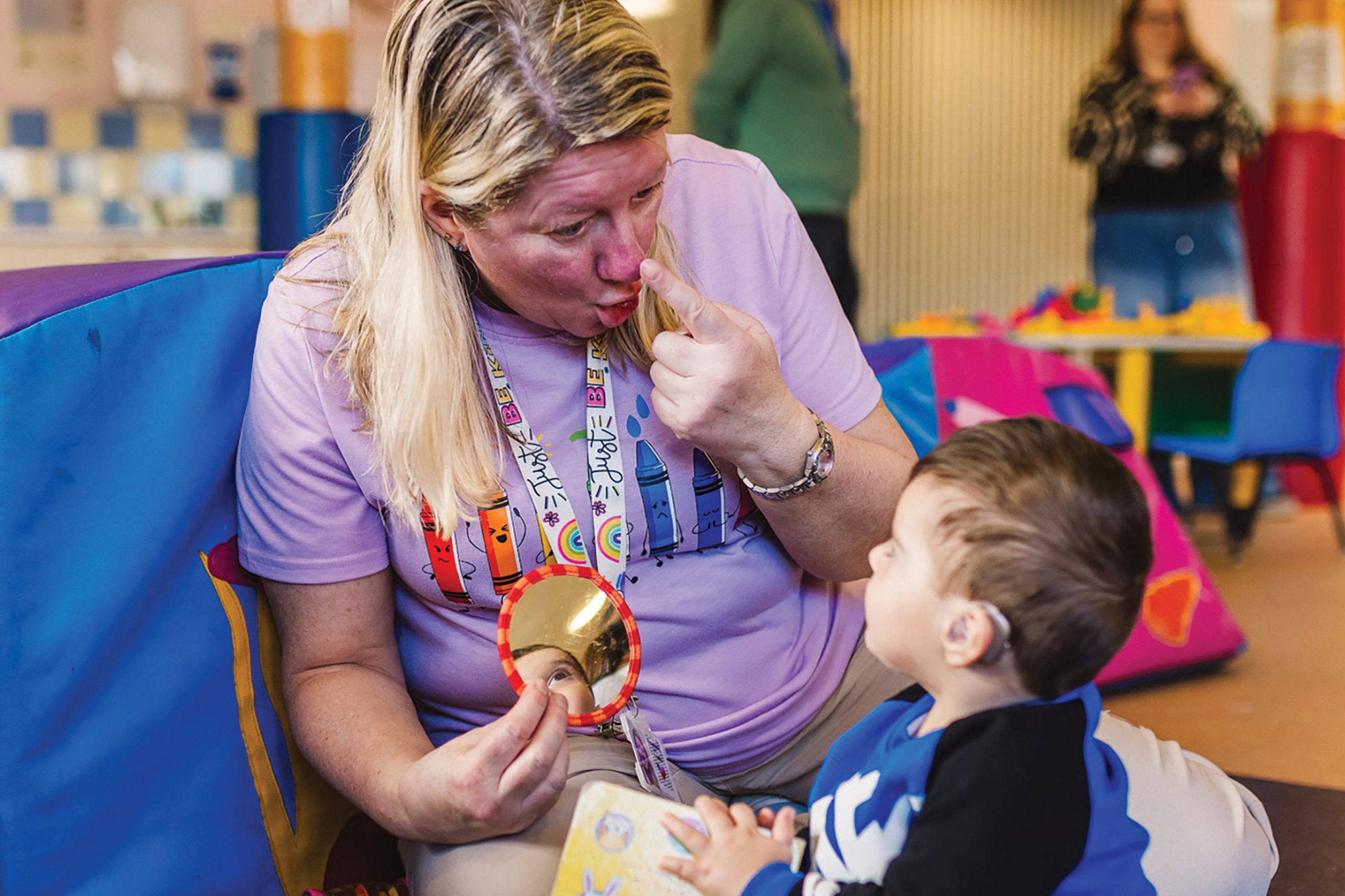
“There is research around social and emotional development, with links between effective communication and better social-emotional outcomes. One study found that stronger communication abilities were associated with better social functioning and fewer behavioural difficulties. Another highlighted that parent-child communication plays an important role in social development, and many deaf children have hearing parents who, initially, may not have a fully effective way to communicate with them. I strongly believe that hearing parents need to be supported to understand their deaf child’s communication needs rather than simply expecting the child to adapt to the hearing world. When parents begin to understand and learn how to communicate with them effectively, it can change the relationship between the parent and child. Parents can move from thinking, ‘Why isn’t my child listening or responding?’ to asking, ‘Have I communicated this in a way my child can fully access?’. That change in perspective is really important. The Togetherness pathway helps them understand that it’s not all about sound, obviously. It’s about the other connections that you can make: laughing, smiling, facial expressions with your child. A deaf child just needs that. Some parents might have already forgotten about this through the shock of the news. We help them to understand that although the child can’t hear, they can still see your facial expressions, your laughter, your emotions, eye contact; and that’s the basis that we start with. They can begin building the emotional empathy and connection between each other.”
Helping deaf children thrive
“Communication is about much more than simply being able to understand what a child is saying. It is about being able to explain emotions, boundaries, consequences, friendships, worries and what is happening around them. A deaf child may appear to be behaving badly when actually they may not have fully understood what has been communicated to them. If a child cannot access the language being used around them, they can miss the explanations and conversations that hearing children may take for granted. For me, the overall message of the pathway is understanding before judgement. When parents understand deafness, language access and their child’s communication needs, they are better placed to support their child’s emotional wellbeing, confidence, education and independence. The message should be that these children don’t need lower expectations; that with accessible communication and the right support, they can achieve the same as their hearing peers. It’s all about raising the emotional wellbeing for these children and young adults. I’m proud to use my own experiences growing up deaf and parenting deaf children into improving this for others, so they don’t fall behind and miss out on the rich experience and connection that’s possible.”